Arkansas Roofing Guidance
Roof Repair in Newport, AR
Review roof repair options in Newport, Arkansas, learn what to report about a leak, and compare repair scope with replacement when needed.
Arkansas Roofing Guidance
Review roof repair options in Newport, Arkansas, learn what to report about a leak, and compare repair scope with replacement when needed.
A ceiling mark, damp wall, missing shingle, or recurring drip can raise questions about what has failed and how much work is needed. In Newport, Arkansas, the first useful step is to note what changed, where it appears, and whether it has happened before rather than guessing at the cause from the indoor symptom.
All Arkansas Roofing connects property owners with independent roofing contractors for roof assessments and estimates. Share the property location, what you can safely observe, and whether the concern affects a home or another building. For the broader local overview, visit the Newport roofing hub.
Water can move along roof decking, framing, insulation, or other surfaces before it appears as a stain or drip indoors. The visible mark may be several feet from the opening, so its position alone cannot identify the roof entry point. Possible areas for assessment include shingles, flashing, valleys, roof edges, and seals around vents or other penetrations. These are possibilities, not a diagnosis; an inspection of the roof and the relevant water path is needed to understand the source.
When calling about a leak, report the room and surface where moisture appears, when it was first noticed, whether it changes during or after rain, and whether the same area has leaked or been repaired before. Mention any safe observations in an attic or upper room, but do not enter an unsafe space or climb onto the roof. Photos taken from indoors or from a stable, ground-level position can document a stain, drip path, or visible roof concern without putting anyone at risk.
Finding the source matters because treating only the visible stain or the nearest roof detail can leave the water path unresolved. A careful assessment helps distinguish the entry point from secondary effects and supports a repair scope aimed at the affected roof components. Interior finishes, insulation, and decking may also need attention if moisture has reached them; that should be explained separately from the roof repair itself.
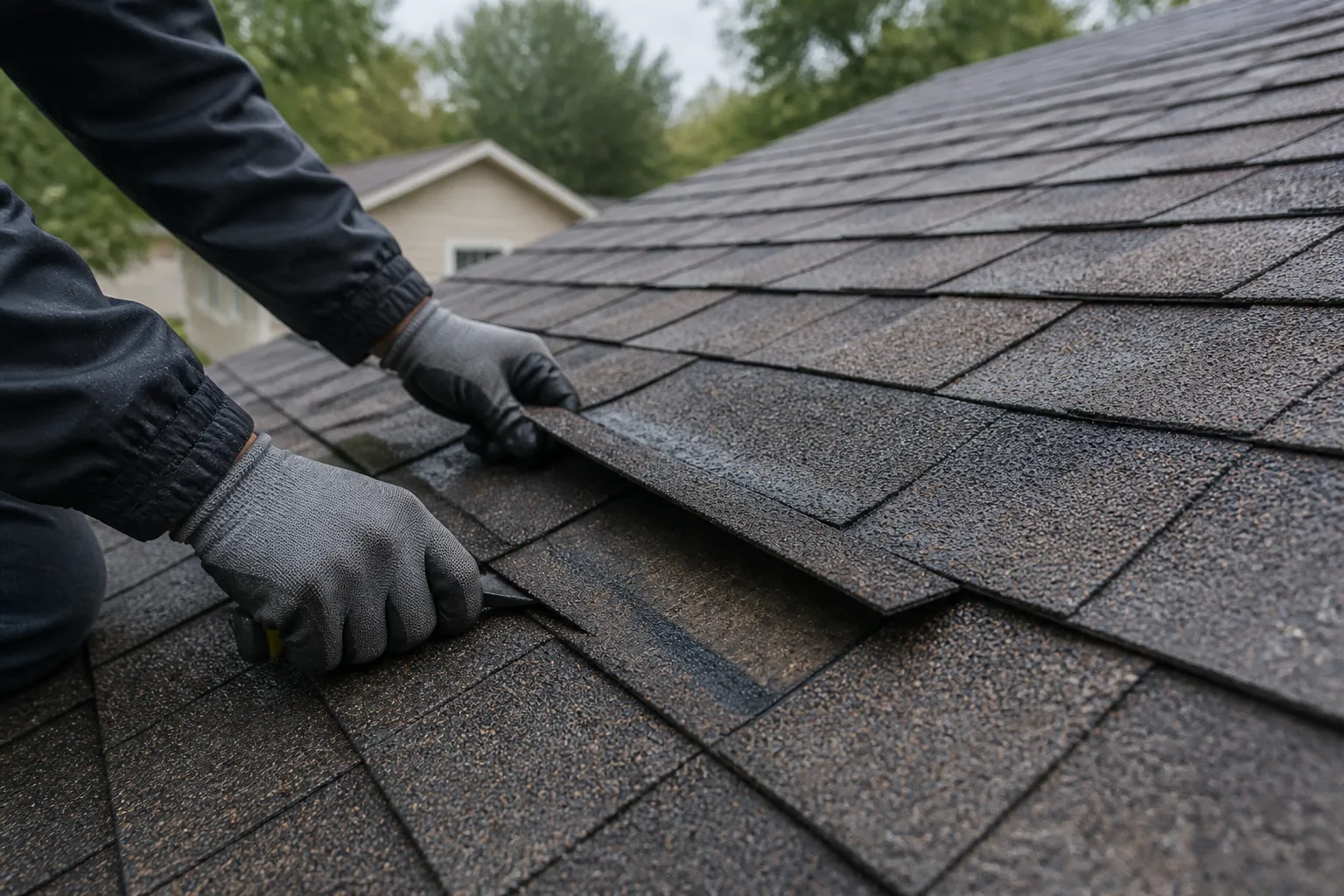
A focused repair can make sense when the observed damage is limited and nearby roofing remains suitable to retain. A written scope should identify the affected section, materials to be removed or replaced, flashing or underlayment included, and any related work that is excluded. Ask how the repair boundary was selected and whether the assessment found nearby conditions that could affect the result.
When a leak returns after prior work, describe what was done, approximately when it was completed, and how the symptoms changed. Repetition does not prove that the earlier repair was wrong or that the entire roof needs replacement. It does mean the source and water path should be reassessed, including transitions, penetrations, and adjacent roof sections where appropriate. The estimate should state what evidence supports the proposed next step.
An assessment may compare interior moisture signs with exterior roof conditions that can be accessed safely. Depending on the roof, this can include the covering, valleys, flashing, penetrations, edges, and the transition between roof sections. The objective is to describe observed conditions and the area of work, not to assume that one symptom corresponds to one failed component.
If water is active near electrical equipment, a ceiling is sagging, or the affected space seems unsafe, keep people clear and report that when requesting help. Avoid puncturing a ceiling, walking on a wet roof, or moving into an unsafe attic to investigate. A photo is useful only when it can be taken from a secure indoor or ground-level position.
Replacement may be worth comparing when wear or damage extends across multiple roof areas, similar leaks recur, or an assessment finds that the broader assembly is no longer a practical candidate for isolated repairs. A single stain, roof age, or a few damaged shingles is not enough by itself to establish that replacement is necessary.
Ask for the repair and replacement reasoning in terms of observed roof condition, work area, and the expected limits of each option. A useful comparison describes which components are included, what remains outside the scope, and any concealed conditions that may change the work after opening the roof. For background on weighing the choices, read Roof Repair or Replacement? How to Compare Your Options. Newport property owners can also review roof repair across Arkansas and the local roof replacement page.
When reviewing proposals, confirm that each estimate addresses the same roof area and the same reported concern. Look for a description of materials, preparation, removal, flashing or underlayment where applicable, protection of the property, debris handling, cleanup, exclusions, and how additional work would be reviewed. If one scope is much broader or narrower, ask what condition explains the difference.
Written estimates are easier to compare when they define the repair boundary and identify related components separately. The roofing estimate checklist can help organize questions before deciding. If the roof is not readily accessible, share safe photos and observations rather than attempting to measure or inspect it yourself.
No. Water may travel along framing or roof layers before becoming visible indoors. The stain is useful information, but the source needs to be assessed rather than inferred from its position.
Describe where water appears, when it happens, whether the area has leaked before, and any prior repair work. Safe indoor or ground-level photos can help communicate what you observed.
Not necessarily. Recurrence calls for a fresh look at the source and affected area. Repair and replacement can be compared based on the observed condition, scope, and limits of each option.
It should identify the work area, materials and components included, exclusions, property protection, cleanup, and how concealed conditions or scope changes will be reviewed.
To start a Newport roof repair inquiry, share the address, building type, visible symptoms, and any known history of the concern through the estimate request. The actual cause and suitable repair scope depend on assessment of the specific roof.
What To Expect
Share your ZIP code, the service you are considering, and what you have noticed about the roof.
Discuss the observed condition, repair or replacement options, and proposed scope with the independent roofer, subject to local availability.
Review materials, work details, cleanup, exclusions, and any additional repairs before deciding how to proceed.
A Few Common Questions
Tell us where the property is and what your roof needs.
Roofing Estimate
Share the property ZIP code and the roofing service you need. The form uses the existing inquiry system.