Arkansas Roofing Guidance
Roof Repair in Little Rock, AR
Learn how roof repair in Little Rock can address leaks, damaged shingles, flashing, roof penetrations, and recurring water intrusion, and when to compare replacement.
Arkansas Roofing Guidance
Learn how roof repair in Little Rock can address leaks, damaged shingles, flashing, roof penetrations, and recurring water intrusion, and when to compare replacement.
A ceiling stain, damp insulation, or water appearing after rain can leave a Little Rock property owner trying to connect the indoor symptom with a roof opening. The visible mark may sit away from the source, so effective repair begins with tracing the likely path and checking the roof components around it rather than patching only the spot where moisture appears.
Roof repair can involve a single damaged shingle, a flashing transition, a roof penetration, or several conditions contributing to recurring water intrusion. Describe when the problem occurs, whether it has returned after earlier work, and what parts of the property are affected. These details help frame an assessment without assuming the cause before the roof is examined. For broader local context, see the Little Rock roofing hub.
Water can travel along roof decking, framing, or other surfaces before a ceiling stain appears. A mark inside a Little Rock home may be some distance from the entry point. Flashing, roof penetrations, damaged shingles, and valleys can be possible places for water to enter, but the visible symptoms alone do not identify which detail is involved.
When calling, describe where water appears, when it happens, and any visible changes since it was first noticed. If it is safe, take photographs from indoors or from ground level; do not climb onto the roof to investigate. Finding the source matters because a repair needs to address the contributing roof detail and water path, not just the place where a stain or drip becomes visible.
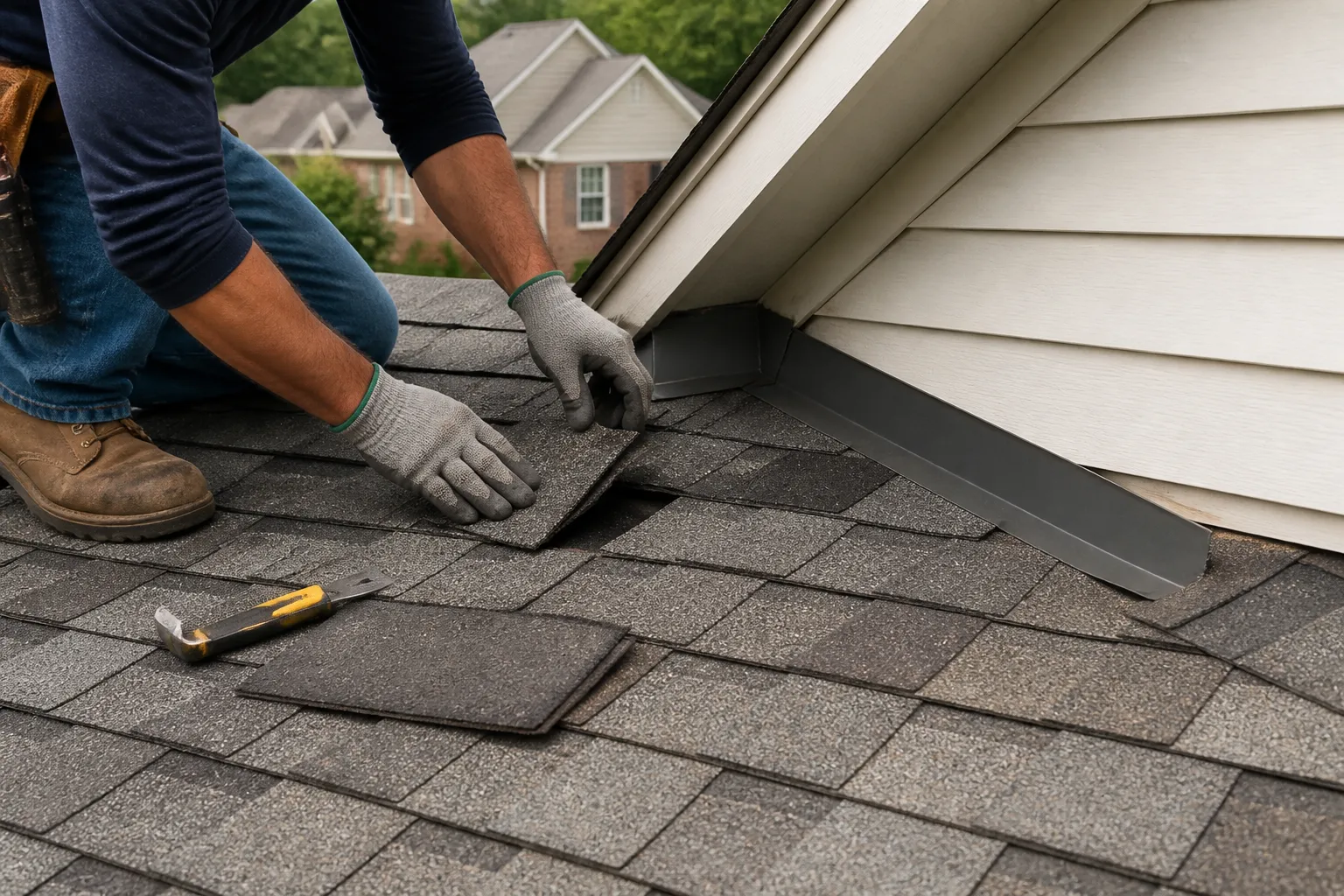
On a shingle roof, missing, cracked, lifted, or displaced shingles can expose the layers beneath them. The repair scope should identify the affected section and explain how new material will connect with the surrounding roof. A visible shingle defect can be a localized problem, but nearby wear, previous repairs, and the condition of adjacent courses matter too.
Flashing protects transitions where roof surfaces meet walls, chimneys, valleys, edges, or other features. If flashing has pulled loose, corroded, bent, or separated, replacing or resetting the visible piece may not be enough unless the adjoining materials are addressed correctly. Roof penetrations such as plumbing vents, exhausts, and other openings also need compatible seals and flashing details. The written scope should say which transitions and penetrations are included, not simply promise to stop a leak.
When water returns after a repair, several explanations are possible: the original source may not have been fully identified, another nearby detail may also be contributing, or the repair did not resolve the connection between roof materials. Ask for the affected areas to be reassessed and for the proposed scope to describe the observed condition, the work planned, and any related components that remain outside it.
Before approving work, compare whether the estimate identifies the roof area, materials, flashing or penetration work, protection of the property, cleanup, and how hidden conditions will be communicated. A bounded scope helps distinguish a targeted repair from broader work. If there are multiple active leaks, widespread wear, repeated patching, or concerns across more than one roof plane, it can be useful to compare repair with replacement instead of treating each symptom independently.
Replacement is worth discussing when the roof’s overall condition suggests localized repairs may not address the wider problem. Relevant observations can include the extent and distribution of damaged material, repeated water entry, deterioration around multiple transitions, prior repair history, and the condition of the roof assembly. No single stain or missing shingle proves that a roof needs to be replaced.
Ask for the reasoning behind both options. If repair is proposed, clarify what it is expected to address and what remains unchanged. If replacement is proposed, request a written scope covering removal, material selection, underlayment, flashing, ventilation where relevant, property protection, cleanup, and how concealed decking conditions will be handled. The roof repair versus replacement guide offers questions for comparing the paths.
Little Rock homes, multifamily properties, offices, and other buildings can have different roof shapes, access constraints, and materials. A residential shingle repair may focus on valleys, eaves, pipe boots, or wall transitions. A commercial or low-slope roof may require attention to membrane seams, drains, scuppers, rooftop equipment, and the way water leaves the roof. The repair scope should reflect the actual assembly and use of the building rather than apply a generic checklist.
For statewide information, review roof repair in Arkansas. If assessment points to a broader project, compare the local Little Rock roof replacement page. Share the property location, building type, visible symptoms, prior repair history, and any safe photos when requesting an estimate. Confirm any project-specific requirements with the office responsible for the property and scope rather than relying on a general statement.
Water can travel along roof decking or framing before it appears indoors, so the stain may be some distance from where water entered. The assessment should trace the likely water path before selecting work.
The relevant area depends on the roof design and the conditions observed. Ask that the assessment identify the suspected source and explain what supports that conclusion.
It should identify the affected areas, proposed materials and work, included flashing or penetration details, property protection, cleanup, exclusions, and how concealed conditions will be addressed. That makes it easier to understand what the repair covers.
Consider both when leaks recur, damage spans multiple areas, or prior repairs have not resolved broader concerns. Ask what evidence supports each option and what conditions would remain after a limited repair.
What To Expect
Share your ZIP code, the service you are considering, and what you have noticed about the roof.
Discuss the observed condition, repair or replacement options, and proposed scope with the independent roofer, subject to local availability.
Review materials, work details, cleanup, exclusions, and any additional repairs before deciding how to proceed.
A Few Common Questions
Tell us where the property is and what your roof needs.
Roofing Estimate
Share the property ZIP code and the roofing service you need. The form uses the existing inquiry system.